Dutch farmers are producing something more expensive than gold.
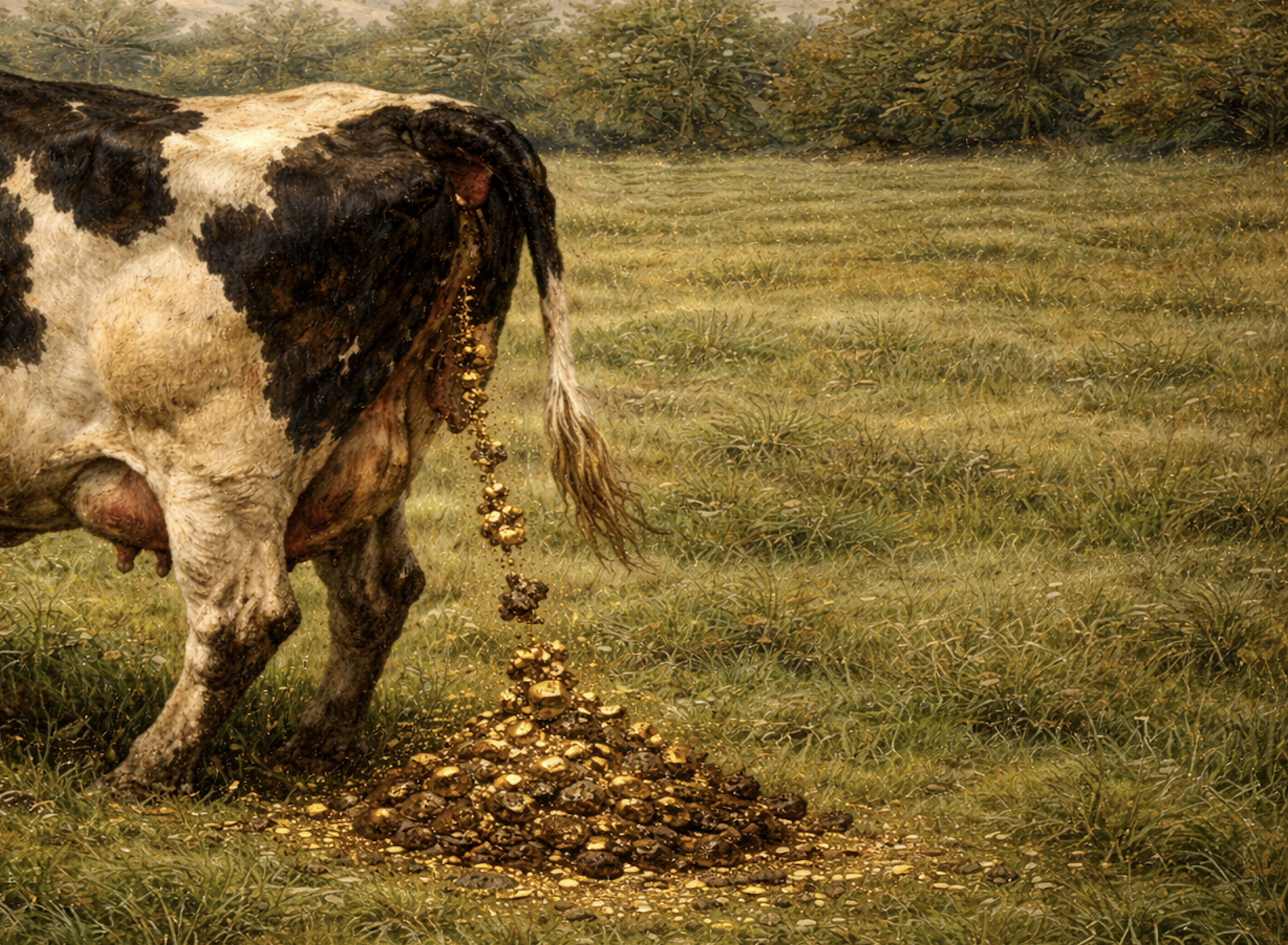
The country’s development is likely more important than maintaining its huge agricultural sector in its entirety, yet taxpayers should not be paying farmers more than the price of gold to quit their farms and reduce emissions.
The Dutch government has allocated close to €2 billion to pay some of its biggest (livestock) farmers to quit their businesses voluntarily.
Readers from most countries might re-read that sentence to confirm, but those that have followed the past years of - ‘Het Stikstofdebat’ - ‘the Nitrogen-debate’, will not be surprised.
The Netherlands is one of the most densely built countries in the world, and in the European Union. Those who visit it often immediately notice that it feels as if each of the scarce square meters in the country is meticulously owned, managed, and zoned for some specific purpose.
One can therefore imagine the pressures placed on the country’s ‘Natura-2000’ nature protection areas, which it is legally required to protect from environmental degradation under the EU’s Habitats & Birds Directives.
In practice, this means that any kind of progress towards solving pressing issues – such as alleviating the housing crisis or developing green infrastructure – has been severely halted and delayed so as to remain within the nitrogen emission limits placed on these protected areas. Housing projects, transmission lines, and other developments struggle to obtain the greenlight due to - ‘Het Stikstofslot’ - the ‘nitrogen lock’ that prevents the country from moving forward.
To remedy this situation, the Dutch government has turned to some of the country’s largest ‘peak-emitters’ – its intensive livestock farmers – attempting to pay them to reduce emissions by ceasing intensive farming operations.
Agriculture is responsible for 47% of yearly nitrogen emissions, but the largest emitters are highly concentrated in livestock-holders close to natural reserves. One specific single turkey farm emits as much nitrogen as the entire country saved by going from a 130km/h top speed to 100 km/h, more on them later.
However, instead of forcing the largest emitters to take the deal and cease operations, or linking the payments proportionally to the actual potential emissions that can be avoided on a case-by-case basis, the Ministry of Agriculture (LVVN) will pay 120% of the market-value of any farm that emits nitrogen above a certain threshold (qualifying roughly 3,000 out of 30,000 livestock farmers) that voluntarily signs up, and a fixed amount per animal.
It does not take an economist to see the issue here. First, there is no proportional incentive relative to the actual nitrogen emissions. An old inefficient farm that pollutes significantly more, might be offered less money than a state-of-the-art installation of the same headcount that emits much less. Second, the low emission threshold (maybe emphasize how low it is relative to other metrics) combined with a price dependent on the value of the farm itself, and the voluntary nature of the scheme, means the effective cost to Dutch taxpayers is comically different across farms.
An analysis by ‘Follow the Money’, ‘NRC’, and ‘Omroep Gelderland’ was able to estimate the costs and abated emissions from various farms that accepted the deal:
1. From the government's perspective, one positive example is that of the previously mentioned turkey farmer family Bakker, who due to outdated practices and proximity of mere meters away from the largest natural reserve in the country - De Veluwe - are the largest of the agricultural emitters. While they weren’t happy about quitting, they eventually agreed to the government’s deal and will be bought out for roughly €1.2 million. This is a lot of money, but in terms of avoided nitrogen emissions, it will cost the State only €0,58 per gram of yearly nitrogen avoided - overall a good deal.
2. Another case is the largest pig farm in the country, with around 30 thousand animals. Because of the farm’s enormous operation it is worth a lot of money, and will be bought out for around €42 million. One might expect an enormous reduction in nitrogen, but its actual emissions were an order of magnitude smaller than the previous turkey farmer, and thus the price per gram of yearly nitrogen avoided is around €239 per gram, according to the analysis. At the time of writing, the gold price has recently hit a historic all-time-high around €150/g and is currently hovering around €130/g.
The current voluntary policy with a relatively low threshold is set to cost around €1.8 billion, for an effective reduction of around 473 grams per hectare. According to the same analysis, the same effect could have been reached by forcing the 133 biggest farmers to take the deal - at a much lower estimated cost of €325 million.
The government itself estimated that around 20% of the 3000 qualifying farms would participate, and by taking the simple average, these 600 farms would reduce the per hectare emissions per year by around 560 grams. Instead, the highly attractive deal attracted at least 723 farms - but the absence of proportional payments, or mandating participation for the largest emitters, meant that even with significantly more farms the final reduction was only 473 grams per hectare per year. On a per-farm basis, that’s a 30% lower reduction of emissions than estimated.
So the Dutch taxpayer pays a fortune; are we at least rid of this nitrogen lock? No, the expected reductions are only around 10% of the amount that we exceed the EU’s critical thresholds with.
I am sure that the political and legal advisors at the relevant Ministries will have plenty of explanations on the feasibility of any alternatives - and I am a strong supporter of decarbonizing our economies and protecting the environment - but in the end it does not take an economist to see the inefficiency here: we should not be paying more than the gold price for emission reductions.